



In product design, inclined angles (slopes) are quite common. This tool lets you easily determine the inclination angle from two sides of a right triangle.
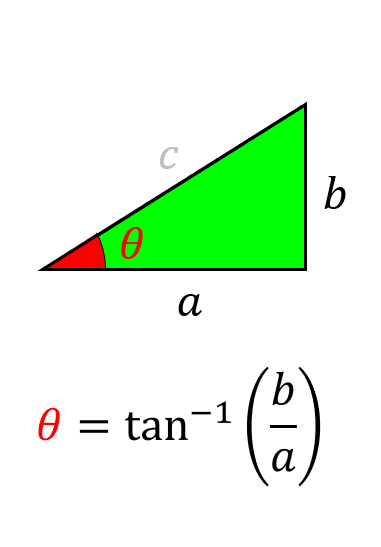
When a and b are known
| θ | = | - rad |
| = | - Deg | |
| = | - | |
| Side c | = | - |
θ = TAN-1(b/a)×180/π =
Deg
c = √(a2 + b2) =
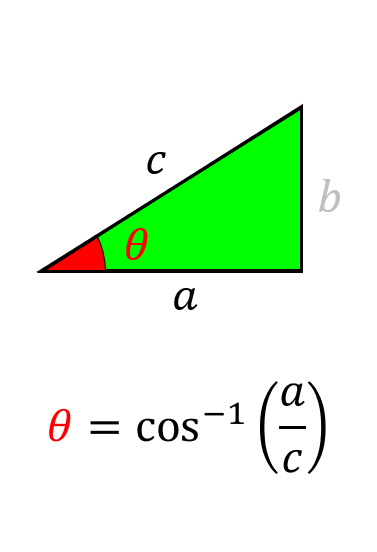
When a and c are known
| θ | = | - rad |
| = | - Deg | |
| = | - | |
| Side b | = | - |
θ = COS-1(a/c)×180/π =
Deg
b = √(c2 - a2) =
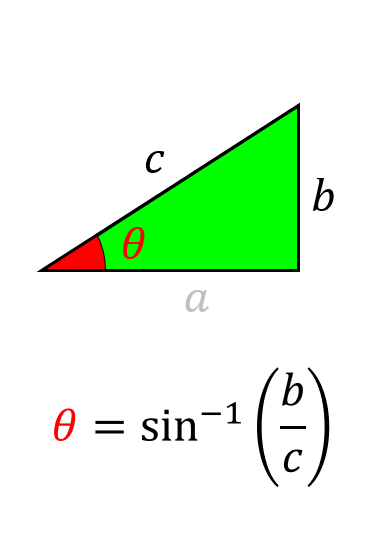
When b and c are known
| θ | = | - rad |
| = | - Deg | |
| = | - | |
| Side a | = | - |
θ = SIN-1(b/c)×180/π =
Deg
a = √(c2 - b2) =
The inclination angle can be calculated if the lengths of two sides of a right triangle are known.
The angle θ calculated by this formula is in radians (rad), using the circular arc system.
There are two angle representation systems: radian and degrees–minutes–seconds. The radian system uses rad; the DMS system uses degrees, where 1°=60 minutes.
What is the radian system?
The radian system expresses the angle where the central angle subtending an arc equal to the radius is 1 radian. (1 rad ≈ 57.3°)
What is the sexagesimal degree system?
The degree system divides a full circle into 360 equal parts. Radians are commonly used in engineering and math, so knowing how to convert between them is essential.
Relationship between radians and degrees
Degrees = Radians × 180 ÷ π
1 rad = 57,3°
1° = π / 180 rad
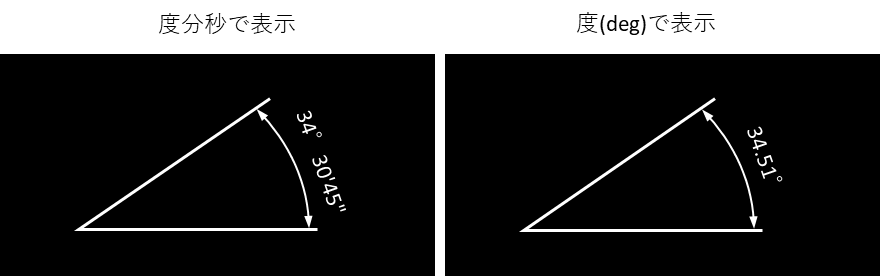
Explanation of angles (degrees · minutes · seconds)
1 minute (1′) = 1/60 of 1 degree. E.g. 30 minutes = 0.5°. Symbol: single prime (').
1 second (1″) = 1/3600 of 1 degree. Symbol: double prime (").
When representing angles smaller than 1 degree in CAD drawings, the DMS notation is sometimes used.
Explanation of side length calculations
For a right triangle with legs a, b and hypotenuse c, the Pythagorean theorem gives:

Therefore, knowing any two sides is sufficient to find the third. E.g. when b and c are known, a is:
